How to Prepare Forensic Medicine for FMGE 2026: High-Yield Topics and Strategy
By Dr. Utsav Bhattacherjee, MBBS, MBA · 26 August 2026 · 9 min read
Forensic Medicine has a short, concentrated syllabus, and its highest-yield content is genuinely learnable as a defined set of timelines, classifications and poison-antidote pairings — closer in structure to Pharmacology or Biochemistry than to the open-ended clinical reasoning of Medicine or Surgery.
FMGE Forensic Medicine high yield topics
- Postmortem changes — the timeline of algor mortis, livor mortis, rigor mortis and putrefaction.
- Asphyxial deaths — classification and the findings associated with each type.
- Wound classification — the medicolegal categories and what distinguishes them.
- Common poisons and antidotes — the defined pairings worth memorising directly.
- Age estimation — the medicolegal methods used, particularly relevant to determining majority.
The postmortem changes timeline
| Change | Onset | Key detail |
|---|---|---|
| Algor mortis (cooling) | Immediate, gradual | Body cools roughly 0.5–1°C per hour depending on conditions |
| Livor mortis (lividity) | 20 minutes–3 hours | Fixes (stops shifting) by 6–12 hours |
| Rigor mortis | 1–2 hours | Follows the rule of twelve: onset about 12 hrs, persists about 12 hrs, resolves in about 12 hrs |
| Putrefaction | 24–48 hours | Greenish discolouration typically starts in the right iliac fossa, closest to the cecum’s high bacterial load |
Lividity colour carries diagnostic significance beyond timing: cherry-red lividity suggests carbon monoxide or cyanide poisoning, while brownish lividity suggests methemoglobinemia (as in nitrite poisoning) — a detail that turns a timing tool into a toxicology clue as well.
Asphyxial deaths: classification worth knowing
Asphyxial deaths are classified by mechanism, and recognising the mechanism from a described scenario is the actual skill being tested. Hanging involves constriction of the neck by a ligature under the weight of the body itself, producing a characteristic inverted V-shaped ligature mark higher on the neck. Strangulation involves external force applied to the neck (by hand — throttling, or ligature pulled by another person), producing a more horizontal mark, often at or below the thyroid cartilage. Smothering involves external blockage of the mouth and nose. Choking involves an internal foreign body obstructing the airway. Drowning involves aspiration of fluid into the airways, with findings like froth at the mouth and nostrils, and water in the lungs and stomach, supporting the diagnosis. Distinguishing hanging from strangulation — via the direction, level and completeness of the ligature mark — is one of the most frequently tested distinctions in this category, given its direct relevance to differentiating suicide from homicide.
Wound classification: the medicolegal categories
Wounds are classified by the mechanism producing them, and each category carries distinct medicolegal significance. Abrasions are superficial injuries from friction or scraping, affecting only the epidermis. Contusions (bruises) result from blunt force rupturing blood vessels beneath intact skin. Lacerations are tears in the skin from blunt force, with irregular, ragged edges — distinct from incised wounds, which are clean-edged cuts from a sharp object. Stab wounds are deeper than they are long, from a pointed weapon, while incised wounds are longer than they are deep. Recognising which category a described wound falls into, and what that implies about the likely weapon or mechanism, is the practical skill this topic tests — a laceration’s irregular margins point toward blunt trauma even without a weapon being specified, while a clean incised wound points toward a sharp object.
Common poisons and their antidotes
| Poison | Antidote |
|---|---|
| Organophosphates | Atropine (plus pralidoxime) |
| Opioids | Naloxone |
| Benzodiazepines | Flumazenil |
| Paracetamol (acetaminophen) | N-acetylcysteine |
| Iron | Deferoxamine |
| Methanol or ethylene glycol | Fomepizole (or ethanol) |
| Cyanide | Hydroxocobalamin or sodium thiosulfate |
| Carbon monoxide | 100% oxygen (hyperbaric oxygen in severe cases) |
These pairings are tested constantly because they are unambiguous, high-value facts — exactly the kind of content that rewards direct memorisation. Organophosphate poisoning deserves particular attention given its continued relevance in agricultural settings in India, presenting classically with cholinergic excess (excessive salivation, lacrimation, urination, defecation — the SLUDGE pattern), miosis and bradycardia.
Age estimation: the medicolegal relevance
Age estimation in forensic contexts relies on a combination of methods — dental development and eruption patterns, ossification centres and epiphyseal fusion on X-ray, and physical examination for secondary sexual characteristics — since no single method is precise enough alone, especially near the legally significant threshold of 18 years. Epiphyseal fusion timing is particularly useful in this age range, since different bones fuse at different, relatively predictable ages, allowing a reasonable estimate of whether someone has crossed the majority threshold even without documentary evidence of birth date.
Vital vs postmortem wounds: a critical distinction
Determining whether an injury occurred before death (antemortem or vital) or after death (postmortem) carries genuine medicolegal weight, since it can distinguish a cause of death from an incidental postmortem injury. Vital reaction — the body’s living response to injury — is the key evidence: a wound sustained while alive typically shows signs like bleeding with clot formation, swelling and inflammatory changes at the wound margins. A wound inflicted after death shows minimal to no bleeding (since circulation has stopped), no swelling and no inflammatory response, since the tissue is no longer biologically reactive. Recognising these features in a described wound is what allows a forensic conclusion about timing relative to death, which is often more clinically and legally significant than the wound type itself.
Identification: beyond age estimation
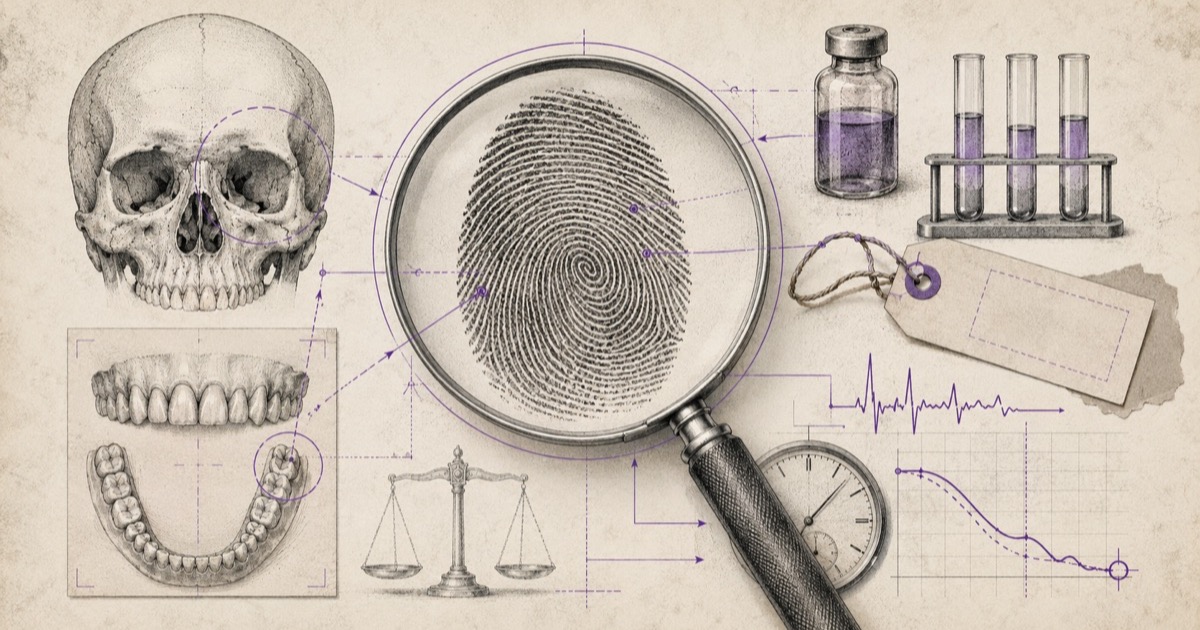
Forensic identification draws on multiple converging lines of evidence rather than relying on any single method, particularly in cases of decomposition or skeletal remains. Dental records offer high specificity when ante-mortem records exist for comparison. Fingerprints remain a reliable identifier when skin is intact enough to obtain them. DNA analysis offers the highest specificity overall but requires viable biological material and appropriate reference samples for comparison. Skeletal analysis can estimate age, sex and stature even from incomplete remains, using features like pelvic morphology (a reliable sex indicator) and long bone measurements. The general principle worth remembering: forensic identification typically triangulates across several available methods rather than depending on one, since each method has different strengths and different failure points depending on the condition of the remains.
A smart study plan for FMGE Forensic Medicine
- Memorise the postmortem changes timeline as a single reference table — it is tested constantly and has a clear, learnable structure.
- Practise distinguishing hanging from strangulation using the ligature mark characteristics — this is one of the most reliably tested distinctions in the whole subject.
- Treat the poison-antidote table as a fixed list worth direct memorisation, similar to how you would approach classic drug-ADR pairs in Pharmacology.
- Learn wound classification by mechanism and vitality (blunt vs sharp, antemortem vs postmortem) rather than as an unstructured vocabulary list.
- Cross-reference forensic identification methods with their limitations — knowing when dental records, DNA or skeletal analysis is most appropriate is as valuable as knowing the methods exist.
For the complete high-yield picture across every FMGE subject, see our FMGE high yield topics guide, and for how Forensic Medicine fits into your overall timeline, our FMGE December 2026 preparation strategy covers the sequencing across subjects.