Types of Wounds for FMGE: What the Wound Itself Tells You About the Weapon
By Dr. Utsav Bhattacherjee, MBBS, MBA · 23 September 2026 · 13 min read
Wound classification in forensic medicine is built around one central purpose: distinguishing what kind of force or weapon produced an injury, since the wound’s own characteristics often tell that story more reliably than witness accounts do. Learn the defining feature of each wound type, and reconstructing the likely mechanism from a description becomes mechanical rather than a guess.
Abrasion
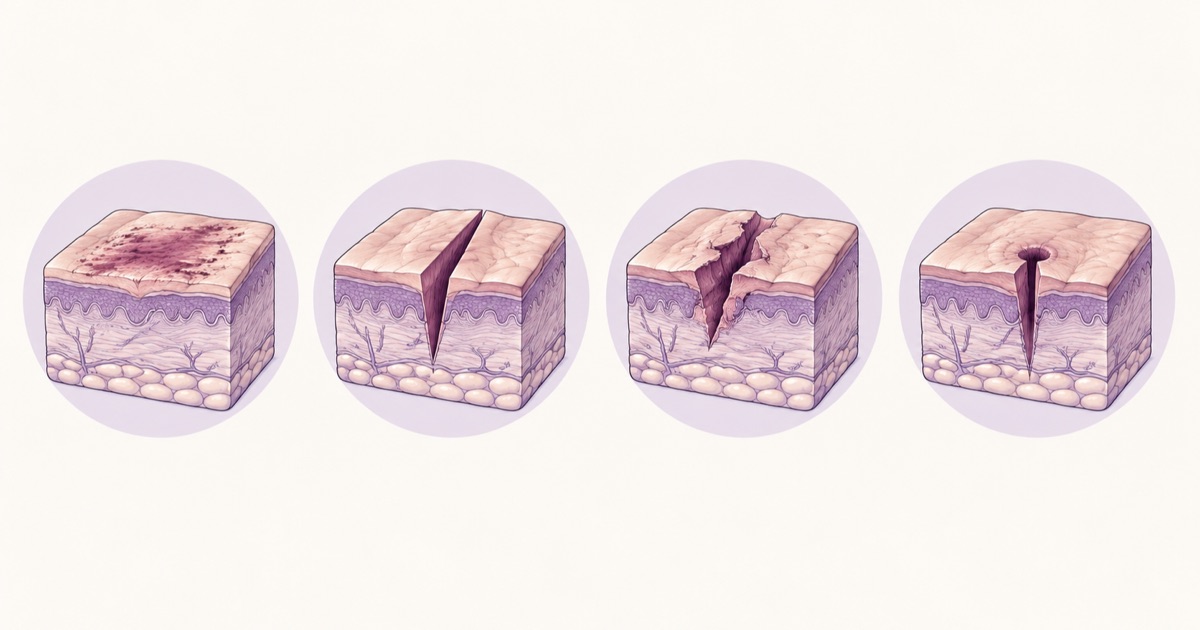
An abrasion is a superficial injury involving only the epidermis, produced by friction or scraping against a rough surface. Because it’s confined to the superficial skin layer, an abrasion typically doesn’t bleed significantly, and its pattern can sometimes preserve a genuinely useful forensic detail — a patterned abrasion can reproduce the texture of the object that caused it, such as tyre marks from a road traffic injury or fabric weave patterns from clothing dragged against skin.
Contusion (Bruise)
A contusion results from blunt force rupturing blood vessels beneath intact skin, producing the characteristic discoloration without any break in the skin surface itself. The color of a contusion changes in a reasonably predictable sequence over time — red or purple initially, progressing through blue, then green, then yellow as the extravasated blood is broken down and reabsorbed — which is why estimating a contusion’s age from its color is a genuinely testable skill, though the exact timeline varies enough between individuals that it should be treated as an approximate range rather than a precise clock.
Laceration
A laceration is a tear in the skin and underlying tissue caused by blunt force, distinct from an incised wound despite both breaking the skin. The defining forensic feature is irregular, ragged edges with tissue bridging — strands of tissue (nerves, blood vessels, or connective tissue) still spanning across the wound rather than being cleanly severed. This tissue bridging is the single most reliable feature distinguishing a laceration from an incised wound produced by a sharp weapon, since a sharp blade cleanly divides tissue with nothing left connecting the two wound edges.
Incised Wound
An incised wound is produced by a sharp-edged weapon drawn across the skin, and its length typically exceeds its depth — the classic signature of a slicing or cutting motion rather than a direct thrust. The wound edges are clean and well-defined, without the ragged irregularity or tissue bridging seen in a laceration, since a sharp edge divides tissue cleanly rather than tearing it. Bleeding tends to be more significant than with an abrasion or a comparably-sized laceration, since a clean cut through blood vessels doesn’t trigger the same degree of vessel-wall crushing and spasm that blunt trauma does.
Stab Wound
A stab wound is produced by a pointed weapon and is distinguished from an incised wound by the relationship between its dimensions: depth exceeds length, the opposite ratio from an incised wound, reflecting a thrusting or penetrating motion rather than a drawing, slicing one. The wound’s external appearance can meaningfully underrepresent its internal severity — a small external opening can still correspond to a deep, potentially fatal internal injury, which is exactly why external wound size alone is an unreliable guide to a stab wound’s actual severity without considering the likely depth and trajectory.
Firearm Wounds: Entry vs Exit
Distinguishing an entry wound from an exit wound is one of the most heavily tested distinctions in this entire topic. An entry wound is typically smaller, often round or oval, and — at close range — surrounded by specific findings including blackening (soot deposition), tattooing (unburned gunpowder particles embedded in the skin), and singeing of surrounding hair, none of which appear at an exit wound. An exit wound is typically larger and more irregular than the corresponding entry wound, without the soot, tattooing, or singeing findings, since the bullet has already lost the hot gases and powder particles that produced those entry-wound features by the time it exits.
The presence or absence of blackening and tattooing also carries information about firing range: contact or near-contact range produces blackening and searing from the hot gases and flame themselves, close range (roughly within arm’s length, though the exact distance varies by weapon and ammunition) produces tattooing from unburned powder particles without necessarily showing contact-range searing, and distant range produces neither finding, since the gases and powder particles disperse before reaching the skin at longer distances.
The Five Types, Side by Side
| Wound Type | Cause | Key Distinguishing Feature |
|---|---|---|
| Abrasion | Friction/scraping | Superficial, epidermis only, can be patterned |
| Contusion | Blunt force, vessel rupture | Discoloration, no skin break |
| Laceration | Blunt force, tearing | Ragged edges, tissue bridging present |
| Incised wound | Sharp edge, slicing | Length exceeds depth, clean edges |
| Stab wound | Sharp point, thrusting | Depth exceeds length, small entry may hide deep injury |
Why Wound Classification Actually Matters Beyond Naming
Correctly classifying a wound isn’t an academic exercise — it directly shapes the reconstructed sequence of events in a medicolegal investigation. Tissue bridging present on a head wound argues for a blunt weapon (a rod, a fall against a hard surface) rather than a knife, regardless of what a witness claims happened. A wound where depth clearly exceeds length points toward a thrusting stab injury rather than a slashing motion, which can matter enormously when the specific sequence or number of blows is contested. Entry and exit wound findings in a firearm injury can establish firing distance and, combined with trajectory, help reconstruct the relative positions of shooter and victim — information that often can’t be reliably obtained any other way once the incident itself has no surviving witnesses or conflicting accounts.
Age Estimation of Wounds
Beyond identifying wound type, estimating how long ago an injury occurred is a related, frequently tested skill. A contusion’s color progression, discussed above, is the most commonly tested example, but wound healing itself follows a broader recognizable sequence: acute inflammation and clot formation in the first day or two, granulation tissue formation over roughly the following week, and progressive scar maturation over weeks to months afterward. A wound showing early granulation tissue is meaningfully older than a fresh, actively bleeding wound, and this kind of staging is frequently how a stated timeline in a case is corroborated or contradicted by the physical findings themselves.
Defense Wounds: A Pattern Worth Recognizing Separately
Defense wounds deserve separate mention because they’re less about wound type itself and more about wound location and pattern telling a story about the circumstances of injury. These are injuries — typically incised wounds or lacerations — found on the palms, forearms, or backs of the hands, consistent with a victim raising their arms or grasping at a weapon in an attempt to protect themselves during an assault. Their presence is forensically significant beyond simply confirming an assault occurred: it argues against a self-inflicted injury and against a purely accidental mechanism, since neither scenario typically produces this specific defensive pattern on the hands and forearms while sparing more centrally exposed areas of the body.
Reading a forensic wound description efficiently means checking three things in sequence: whether the edges are clean or ragged (sharp versus blunt mechanism), whether length or depth dominates (slicing versus thrusting, for sharp-force wounds specifically), and whether any range-of-fire findings like blackening or tattooing are present for a firearm wound. These three checks resolve the great majority of wound-classification questions before any weapon needs to be named outright.