Antidotes for Common Poisonings for FMGE: The Drug-to-Poison Table Worth Memorizing Cold
By Dr. Utsav Bhattacherjee, MBBS, MBA · 9 September 2026 · 11 min read
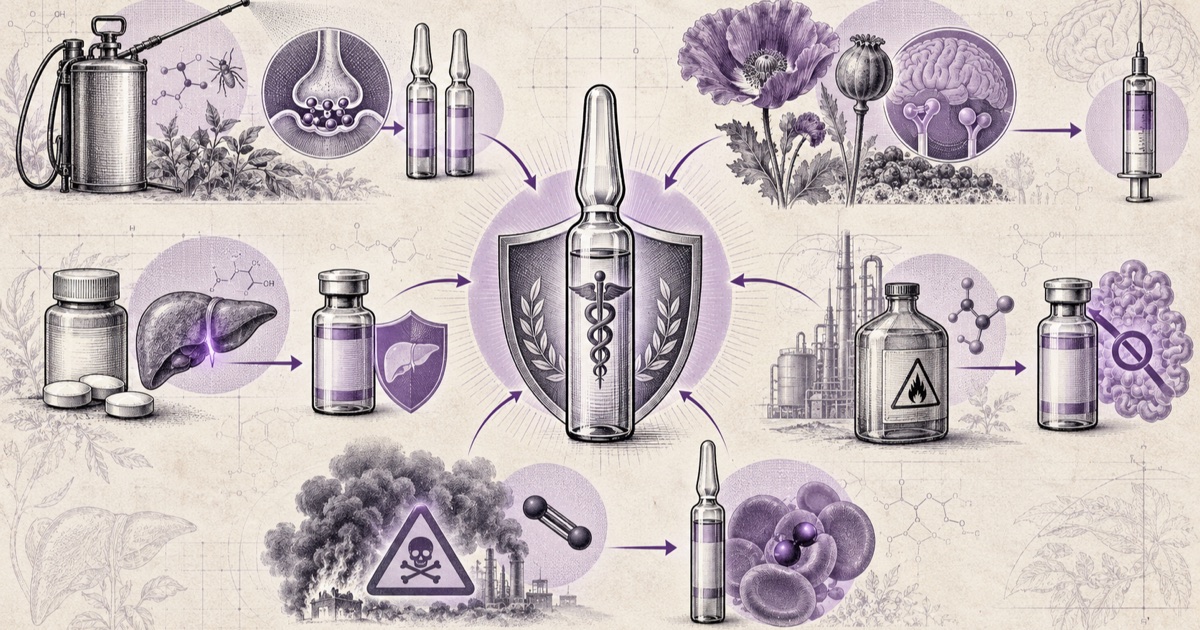
Antidote questions are some of the most reliably scored marks on the whole exam, provided the pairing is genuinely memorized rather than half-remembered. The list below is organized by the mechanism behind each pairing, not just the name to match — mechanism is what keeps a memorized fact from sliding out of reach under exam pressure. Once the pairings are solid, practise them against real FMGE previous year questions.
Organophosphate Poisoning: Atropine and Pralidoxime
Organophosphates (found in many pesticides) irreversibly inhibit acetylcholinesterase, causing a build-up of acetylcholine at synapses throughout the body — producing the classic cholinergic toxidrome: salivation, lacrimation, urination, defecation, GI distress, and emesis (often remembered as the SLUDGE mnemonic), alongside bradycardia, miosis, and bronchorrhea (excessive bronchial secretions).
Atropine is the first-line antidote, acting as a competitive muscarinic receptor antagonist — it directly blocks the effect of the excess acetylcholine at muscarinic receptors, addressing the immediately life-threatening bronchorrhea and bradycardia. Pralidoxime works differently and is genuinely complementary rather than redundant: it reactivates acetylcholinesterase itself by breaking the bond between the enzyme and the organophosphate, provided it’s given before the bond "ages" and becomes permanent — which is why pralidoxime is most effective when given early, and loses effectiveness the longer treatment is delayed.
The detail worth holding onto: atropine treats the symptoms of excess acetylcholine; pralidoxime treats the underlying enzyme inhibition itself. They’re given together, not as alternatives to each other.
Opioid Overdose: Naloxone
Opioids cause their effects, including the dangerous respiratory depression that kills in overdose, by binding to mu-opioid receptors. Naloxone is a competitive mu-opioid receptor antagonist — it directly displaces the opioid from the receptor, reversing respiratory depression rapidly, often within minutes of administration.
A detail worth knowing for exam purposes: naloxone’s duration of action can be shorter than that of the opioid causing the overdose, particularly with longer-acting opioids. This means a patient can be successfully reversed and then relapse back into respiratory depression once the naloxone wears off before the original opioid has cleared — which is why observation after reversal, and sometimes repeated dosing, matters clinically and shows up as a testable point.
Benzodiazepine Overdose: Flumazenil
Benzodiazepines enhance GABA-A receptor activity, producing their sedative and anxiolytic effects. Flumazenil is a competitive antagonist at the benzodiazepine binding site on the GABA-A receptor, reversing sedation.
The exam-relevant caution here matters more than the mechanism: flumazenil is used cautiously, and is often specifically avoided, in patients with a seizure history or in cases of mixed overdose involving pro-convulsant drugs (such as tricyclic antidepressants) — because rapidly reversing the benzodiazepine’s GABA-enhancing effect can unmask or trigger seizures that the benzodiazepine itself may have been suppressing. This makes flumazenil one of the few antidotes on this list where the exam is as likely to test when not to use it as when to use it.
Paracetamol (Acetaminophen) Overdose: N-Acetylcysteine
Paracetamol overdose is dangerous specifically because of a toxic metabolite, NAPQI, normally produced in small amounts and safely neutralized by glutathione. In overdose, glutathione stores are overwhelmed, and accumulating NAPQI causes severe hepatotoxicity — this is genuinely a delayed-onset danger, since liver damage typically isn’t apparent for 24–72 hours after ingestion, well after the patient may feel deceptively fine.
N-acetylcysteine (NAC) works by replenishing glutathione stores, restoring the body’s capacity to neutralize NAPQI before it causes hepatocyte damage. The detail worth knowing specifically: NAC’s effectiveness is highly time-dependent — it’s most protective when given early, ideally within 8–10 hours of ingestion, though it’s still given later in the course since some benefit persists even after that window, particularly once hepatotoxicity is already evident.
Other High-Yield Pairings Worth Locking In
- Iron poisoning → Deferoxamine, a chelating agent that binds free iron for excretion.
- Digoxin toxicity → Digoxin-specific antibody fragments (Digibind/DigiFab), which bind circulating digoxin directly and remove it from its site of action.
- Methanol or ethylene glycol poisoning → Fomepizole (or, where unavailable, ethanol), which works by competitively inhibiting alcohol dehydrogenase — the same enzyme responsible for converting methanol and ethylene glycol into their genuinely toxic metabolites in the first place. Blocking that conversion is the entire point of treatment.
- Cyanide poisoning → Hydroxocobalamin (or sodium thiosulfate/sodium nitrite), which works by binding cyanide directly, forming a compound the body can excrete safely.
- Heparin overdose → Protamine sulfate, which binds and neutralizes heparin directly through an ionic interaction.
- Warfarin overdose → Vitamin K (with fresh frozen plasma or prothrombin complex concentrate for urgent reversal), restoring the vitamin K-dependent clotting factors warfarin suppresses.
- Beta-blocker overdose → Glucagon, which raises intracellular cAMP through a receptor pathway independent of the blocked beta-receptor, restoring cardiac contractility despite the beta-blockade.
- Methemoglobinemia → Methylene blue, which helps reduce methemoglobin back to functional hemoglobin.
Digoxin Toxicity: Digoxin-Specific Antibody Fragments
Digoxin toxicity deserves fuller treatment than a one-line mention, since it’s genuinely rich in testable detail. Digoxin works by inhibiting the Na+/K+-ATPase pump in cardiac cells, and toxicity classically presents with nausea, visual disturbances (classically described as yellow-green halos around lights), arrhythmias, and hyperkalemia — the hyperkalemia specifically arises because the same pump inhibition that increases cardiac contractility also disrupts normal potassium handling across cell membranes.
Digoxin-specific antibody fragments (Digibind or DigiFab) work by binding circulating digoxin directly, forming a complex the kidneys can excrete, effectively pulling the drug out of circulation and away from its site of action on the Na+/K+-ATPase pump. This is a genuinely different mechanism from receptor antagonism or enzyme reactivation — it’s direct removal of the offending molecule itself, more similar in principle to chelation than to blocking a receptor.
A detail worth knowing specifically: digoxin toxicity is more likely in the setting of hypokalemia paradoxically, since digoxin and potassium compete for the same binding site on the pump — low potassium effectively increases digoxin’s binding and its toxic effect at a given digoxin level. This is why digoxin toxicity risk is assessed alongside potassium status, not just digoxin level alone.
General Principles of Decontamination
Beyond specific antidotes, a few general decontamination principles come up often enough as standalone exam points to be worth knowing separately from any single poison. Activated charcoal works by adsorbing many toxins onto its surface within the gut, reducing systemic absorption — but it’s most effective when given within roughly one hour of ingestion, and it doesn’t meaningfully bind certain substances at all, notably alcohols, iron, lithium, and other small, highly water-soluble ions, which is a frequently tested exception to an otherwise broadly useful intervention.
Induced vomiting (historically via syrup of ipecac) has fallen out of favor in modern poisoning management and is now avoided in most circumstances — the risks (aspiration, delayed presentation to definitive care, limited evidence of actually improving outcomes) are now generally considered to outweigh the benefits compared to activated charcoal or other measures, which is itself a testable shift in standard practice worth knowing rather than assuming ipecac is still first-line.
The Pattern Worth Noticing Across All of These
Toxicology is examined from two directions on FMGE — the drug mechanisms in how to prepare Pharmacology for FMGE, and the poisons themselves in how to prepare Forensic Medicine for FMGE, which is where the toxicology syllabus formally sits. Almost every antidote on this list works through one of a small number of mechanisms: direct receptor antagonism (naloxone, flumazenil), enzyme reactivation or inhibition (pralidoxime, fomepizole), chelation or direct binding (deferoxamine, hydroxocobalamin, protamine, digoxin-specific antibody fragments), or replenishing a depleted protective substance (N-acetylcysteine, vitamin K). Sorting a new or unfamiliar antidote into one of these four categories, once you understand the underlying poisoning mechanism, is often enough to reason toward the right answer even for a pairing not explicitly memorized in advance.